Wolf repair · Coffee systems
When the built-in Wolf coffee machine stops pouring
A built-in Wolf coffee system hides a ceramic grinder, a brew unit, a pump, a thermoblock heater and a milk frother behind one flush stainless door, all answering to a single control board. Chicago's hard water and daily use wear on each of them differently, so a machine that stops pouring may be held up by scale, a stiff brew unit or a pump that has lost pressure. We test each part where it sits and repair it in your wall cabinet across the North Side of Chicago. Call (872) 266-4445 or choose a visit time.
4.9 out of 5 for Wolf Coffee System Repair, from 87 customer reviews About the reviews
Straight answer
Why is my Wolf built-in coffee system not brewing?
If the machine grinds but no coffee comes out, the water side has stalled: a blocked or stiff brew unit, a pump that has lost pressure, or a water circuit narrowed by scale. In Chicago's hard water, scale is the most frequent cause. A technician can clear the circuit and test the pump and brew unit.
Six faults behind a cup that never arrives
Each sign below points to the part we test first. Its neighbors get checked too, because a tired pump and a scaled heater can look alike from the outside.
- Grinder louder than usual, grind uneven, or no grinding at all
- Likely cause Worn or jammed ceramic burrs, a foreign object in the hopper, or a tired grinder motor
- No water reaches the brew unit, or water leaks inside the cabinet
- Likely cause Pump, inlet or outlet valves, a cracked hose or a loose fitting in the water circuit
- Coffee comes out too hot, lukewarm or different every cup
- Likely cause Thermoblock heater or its temperature sensor
- Brew unit stuck, will not cycle or will not come out
- Likely cause Dried coffee residue, missing lubrication or a broken brew unit part
- Flow slows, steam weakens, white crust on parts
- Likely cause Scale from hard water building up through the circuit Repair details
- Error codes or a frozen menu
- Likely cause A sensor reporting a fault, or the control board itself Repair details
Weak coffee is rarely the beans
-
People sayWeak or sour coffee means I bought the wrong beans.
In practiceBeans can matter, but in a machine that used to taste right the usual suspects are worn burrs, a grind setting that drifted, low pump pressure or scale in the brew chamber. All of these can be measured.
-
People sayThe descaling program handles all the scale.
In practiceThe built-in program helps, but scale deep in valves and the thermoblock can survive it, especially with hard city water. A slow, noisy pump after descaling is a sign the circuit still needs attention.
-
People sayIf it still makes coffee, it does not need service.
In practiceA brew unit running dry or a pump straining against scale keeps working until it suddenly does not. A yearly professional service for regular users catches these before a breakdown.
-
People sayOlder or discontinued Wolf coffee systems cannot be fixed.
In practiceWe repair current and discontinued models. Parts for older units can take longer to find, and we tell you that before you decide.
Straight answer
Why is my Wolf coffee machine grinder noisy or not grinding?
A grinder that turns loud, grinds unevenly or stops usually has worn or jammed ceramic burrs, a small stone or foreign object in the beans, or a failing grinder motor. Stop running it if it strains, since forcing it can damage the burrs further. A technician can open the grinder, clear it and test the motor.
Follow the coffee: what we check, station by station
We test the machine in the same order the coffee moves through it. That way the first broken link is found, not just the loudest one.
-
Beans and grinder
We check the hopper, the burr surfaces and the grind setting, listen to the motor under load and confirm the grind is consistent.
-
Dose and brew unit
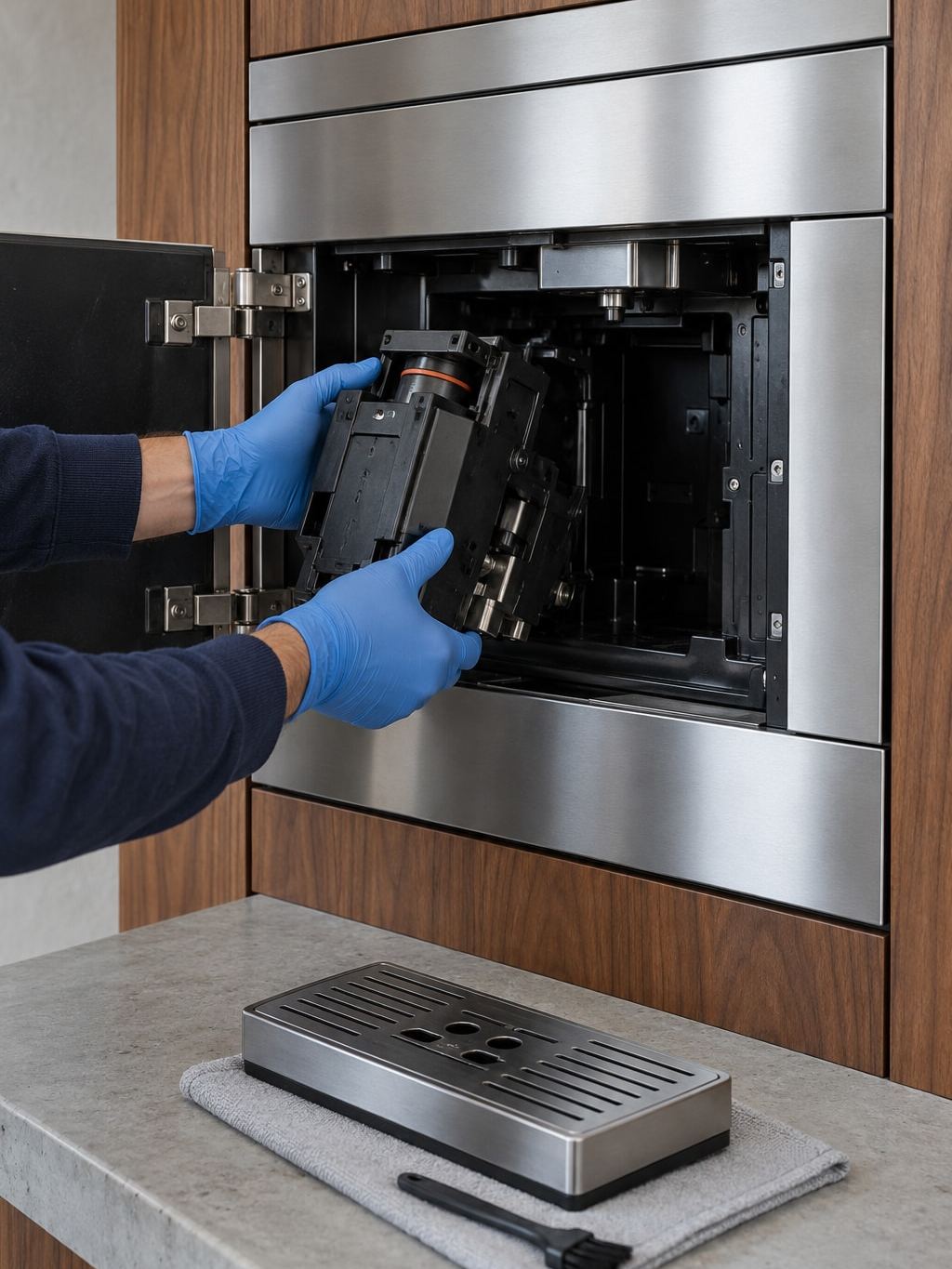
The brew unit compacts the ground coffee and holds it while water passes through. We remove it, inspect seals and moving parts, clean off packed residue and lubricate it to spec.
-
Water supply and pump
We test pump pressure, check the inlet and outlet valves and follow the water circuit for leaks or narrowed passages.
-
Heating
The thermoblock and its sensor are tested so the water reaches the right temperature, not scalding and not tepid.
-
Milk and frothing
On models with automatic frothing, we check that milk is drawn, heated and foamed properly and that the lines are clear.
-
Electronics and the final cup
We read stored faults, check the control board, then brew several cups to confirm extraction, temperature and flow before we leave.
Each part, and the work it may need
After diagnosis you see which parts need work and the cost of each, laid out before anything is replaced. Nothing starts without your approval, and there are no surprise charges. How a quote is built is on our pricing page.
| Component | What goes wrong | What we do |
|---|---|---|
| Grinder burrs and motor | Noise, uneven grind, jams, no grinding | Clear and inspect the burrs, replace worn burrs or the motor |
| Pump and valves | No water, weak flow, leaks | Pressure test, replace the pump or valves, reseal fittings |
| Thermoblock | Coffee too hot, too cool or inconsistent | Test heater and sensor, replace the failed part |
| Brew unit | Stuck, not cycling, leaking grounds | Clean, lubricate, replace worn seals or the unit |
| Water circuit | Scale, slow flow, crust on parts | Professional descaling and flushing of the full circuit |
| Control board | Error codes, frozen menu, no response | Read faults, test inputs, repair or replace the board |
Straight answer
Who repairs built-in Wolf coffee machines in Chicago?
Urban Wolf Repair Chicago repairs built-in Wolf coffee systems across Lincoln Park, Lakeview, Wrigleyville, Bucktown, Logan Square and DePaul on Chicago's North Side. Wolf kitchen equipment is all we touch, coffee machines included, and the fix happens with the unit still in the wall. We run independently of the Wolf brand. Our $89 trip charge gets deducted from the repair bill.
Chicago water and your coffee system
Lake Michigan water is hard enough that scale is the background story of most coffee system repairs we do. Minerals settle wherever water is heated or slowed: inside the thermoblock, in the narrow passages of the valves, around the brew unit. The result is slow flow, a pump that sounds strained and coffee that tastes flat even with fresh beans.
Regular descaling with the machine's own program and a water filter, if your model takes one, slow this down. For daily and weekly habits, see our coffee system care tips. For anyone using the machine every day, we suggest a professional service about every 12 months: full descaling of the circuit, a brew unit service, a grinder check and a look at the water lines.
The same water affects other Wolf appliances in your kitchen, especially a steam oven. If both need attention, one visit covers both, and you are billed the $89 trip charge a single time no matter how many appliances get checked. All the Wolf appliances we work on are listed on our services page.
Coffee system questions
- My Wolf coffee system grinds but no coffee comes out. What's going on?
- The grind side works, so the problem is downstream: the brew unit may be stuck or clogged, the pump may not be building pressure, or scale may be blocking the water circuit. Running repeated cycles will not clear it. Schedule a technician to trace it.
- How often should a Wolf built-in coffee machine be professionally serviced?
- For regular daily use, about once every 12 months. That covers thorough descaling, brew unit cleaning and lubrication, a grinder check and an inspection of the water lines. Lighter users can stretch it a bit, but hard water argues against waiting too long.
- Can the machine be repaired without taking it out of the wall?
- Most repairs happen with the machine in its cabinet. The brew unit, grinder area and water connections are reachable from the front of the unit. If a unit does need to slide out, we handle the surrounding cabinetry carefully.
- Why does my coffee taste weaker than it used to?
- In a machine that once tasted right, look at the hardware before the beans: worn burrs, a grind that has drifted coarser, low pump pressure or scale in the brew chamber. We measure each of these during a visit instead of guessing.
- The machine shows an error code. Should I keep restarting it?
- One restart is fine. If the code comes back, write it down and stop cycling the machine, since some faults involve water or heat. Our error code guide explains the common families of codes.
- Do you work on discontinued Wolf coffee systems?
- Yes. Older and discontinued models are repairable, though parts can take longer to locate. You hear how long the wait looks before you approve the repair so you can decide with the full picture.